
The Complete Guide to Foundation Repair in Vancouver, BC
Jump To Section:
Why Vancouver Foundations Are Vulnerable
Vancouver’s real estate market means homeowners are protecting significant investments, and the city’s geography makes foundations particularly vulnerable. The city sits on a complex mix of geological conditions, from the bedrock exposures on the North Shore to the deep marine clays beneath the flats of the Fraser River delta to the fill that underlies many of the city’s waterfront and reclaimed areas.
Add in Vancouver’s heavy rainfall, its position in one of Canada’s most active seismic zones, and an aging housing stock that includes homes built long before modern foundation standards, and you have conditions that are hard on foundations.
Many Vancouver homes were built in the early to mid-20th century with construction methods that were standard for the time but do not meet today’s understanding of soil behaviour and seismic risk. As these homes age, the cumulative effects of soil movement, moisture, and time begin to show.
Common Foundation Problems in Langley
Settling Foundations
Bowing Basement Walls
Foundation Cracks
Water Intrusion
Aging Foundation Materials
Vancouver Soil Conditions
Vancouver’s soil conditions vary dramatically across the city, which is why two homes a few blocks apart can have completely different foundation experiences.
Marine clay and silt underlie much of Vancouver’s low-lying areas, particularly south of King Edward Avenue, along the Fraser River flats, and through Marpole, South Vancouver, and Killarney. These soils are soft, compressible, and sensitive to disturbance.
Glacial till is found on higher ground in areas like Kerrisdale, Dunbar, Point Grey, and parts of the west side. Till is generally more stable and provides better bearing capacity, though it can contain pockets of softer material.
Fill soil is present in many areas that were developed on former tidal flats, creek beds, or low-lying ground. Parts of False Creek, the Flats, Strathcona, and the waterfront were built on fill of varying quality. Some of this fill is over a century old and continues to settle.
Bedrock exposures exist in limited areas, particularly near the North Shore interface and some higher elevations. Properties fortunate enough to sit on or near bedrock generally have the most stable foundations.
Organic soils are found near former bog areas and stream corridors throughout the city. These are highly compressible and problematic for foundations.
The soil beneath your specific property determines everything about how your foundation should be repaired. Our assessment identifies what you are built on before we recommend a solution.
Repair Options for Vancouver Homes
The right solution for your Vancouver home depends on the foundation type, soil conditions, and the nature of the problem. Here are the main options:
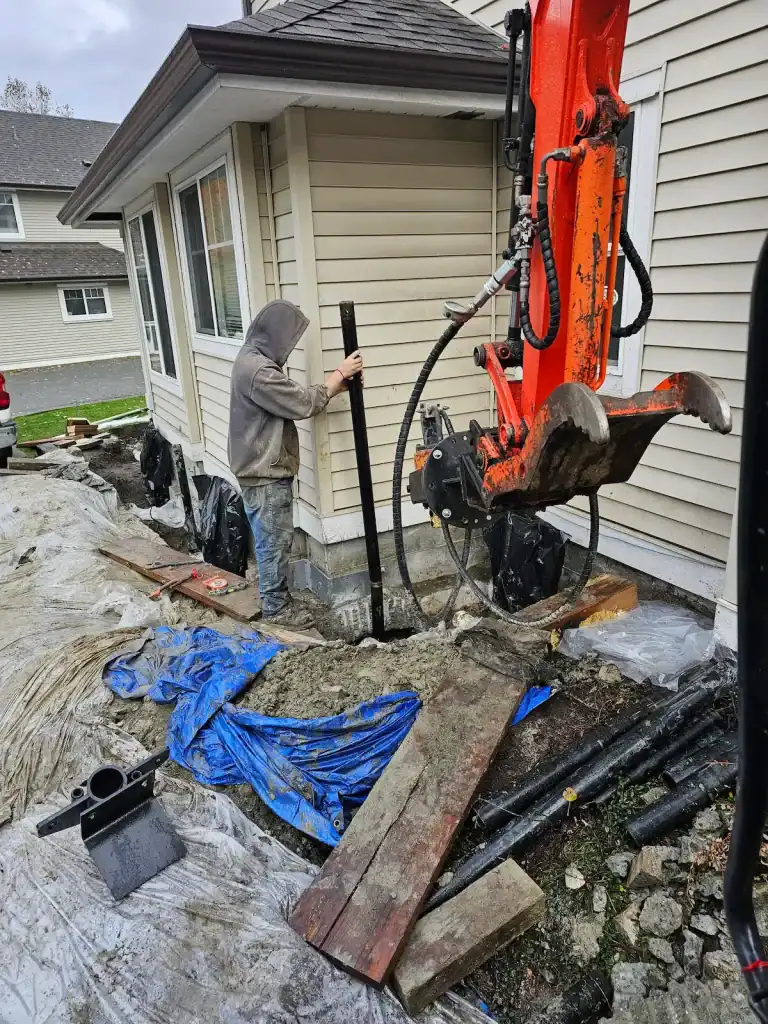
Helical piles are screwed through Vancouver’s soft surface soils to reach a stable bearing layer. They are effective across a wide range of the city’s soil conditions and work well for homes with limited access, important in Vancouver, where lot sizes are tight, and neighbouring structures are close.
Learn more about helical piles →
Push piers are driven to bedrock or a competent bearing layer using the building’s weight as resistance. For heavier Vancouver homes experiencing active settlement, particularly those on deep marine clay, push piers provide a reliable path to stable ground and can often lift the foundation back toward level.
Carbon fiber reinforcement stabilizes bowing basement walls without excavation. For Vancouver homes where lateral soil pressure is pushing basement walls inward, carbon fiber straps stop the movement and add structural capacity. This is especially practical in the city where exterior excavation can be complicated by tight lot lines and neighbouring properties.
Learn more about carbon fiber →
Not sure which solution is right for your situation?
Seismic Considerations
Vancouver is in one of Canada’s most active seismic zones. The Cascadia Subduction Zone, the most significant seismic threat in the region, is capable of producing a major earthquake. Smaller, more frequent events from local fault systems also pose risk.
For foundations, seismic activity matters because earthquakes can cause sudden settlement, lateral displacement, and in areas with soft or saturated soils, liquefaction, where the ground temporarily behaves like liquid and loses its ability to support structures.
Homes built before modern seismic standards are most at risk. If your foundation is already compromised by settlement or cracking, it is more vulnerable to earthquake damage than a sound foundation.
Helical piles and push piers can improve a foundation’s seismic resilience by connecting the structure to stable ground below the vulnerable surface soils. Ram Jack® pier systems have been tested for seismic performance at the University of California, San Diego, demonstrating predictable behaviour under earthquake conditions.
Choosing a Foundation Repair Company
Vancouver has several companies offering foundation repair services. Here is what to look for:
Do they understand Vancouver’s soil variability? The city’s geology changes significantly from neighbourhood to neighbourhood. A company should assess your specific property, not apply a one-size-fits-all solution.
What products do they install? Ask about the brand, whether the products carry a manufacturer’s warranty, and whether the company is an authorized dealer.
Can they work in tight spaces? Vancouver lots are often narrow with limited access between homes. The company’s equipment and methods need to be compatible with the site constraints common in the city.
What does the warranty cover? Understand the difference between a product warranty and an installation warranty. Both should be included, and both should transfer if you sell.
Will they provide everything in writing? A clear written proposal with the recommended solution, number of piers, timeline, and price should come before any commitment.
What to Expect During The Repair
Assessment
Proposal
Installation
Completion
Costs and Financing
Foundation repair costs in Vancouver vary based on the scope of work. The number of piers needed, the depth to stable soil, site access (which can be more challenging in the city), and the system used all factor into the price.
Vancouver property values make foundation repair an investment worth protecting. An unresolved foundation issue affects resale value, insurance, and your peace of mind.
We provide transparent pricing in every proposal and offer financing through Financeit with flexible terms, fixed monthly payments, and no penalty for early payoff.
Frequently Asked Questions
Very common. Vancouver's combination of marine clay, fill conditions, heavy rainfall, aging housing stock, and seismic risk makes it one of the most foundation-problem-prone cities in Canada. We work in Vancouver neighbourhoods regularly.
Areas built on soft marine clay and fill tend to have more problems. This includes much of South Vancouver, Marpole, Killarney, parts of East Vancouver, and areas near former tidal flats. Higher-ground neighbourhoods like Dunbar, Kerrisdale, and Point Grey generally have better bearing conditions, though individual lots vary.
If your foundation is already compromised by settlement or cracking, it is more vulnerable to earthquake damage. Repairing and stabilizing your foundation improves its resilience. The pier systems we install have been tested for seismic performance.
Permit requirements depend on the scope of work and the City of Vancouver's current regulations. We handle all necessary permitting and ensure the work meets local code requirements.
Yes. We have experience working on older and heritage properties where care is needed to preserve the existing structure while stabilizing the foundation. The methods we use can be adapted to work within heritage conservation requirements.