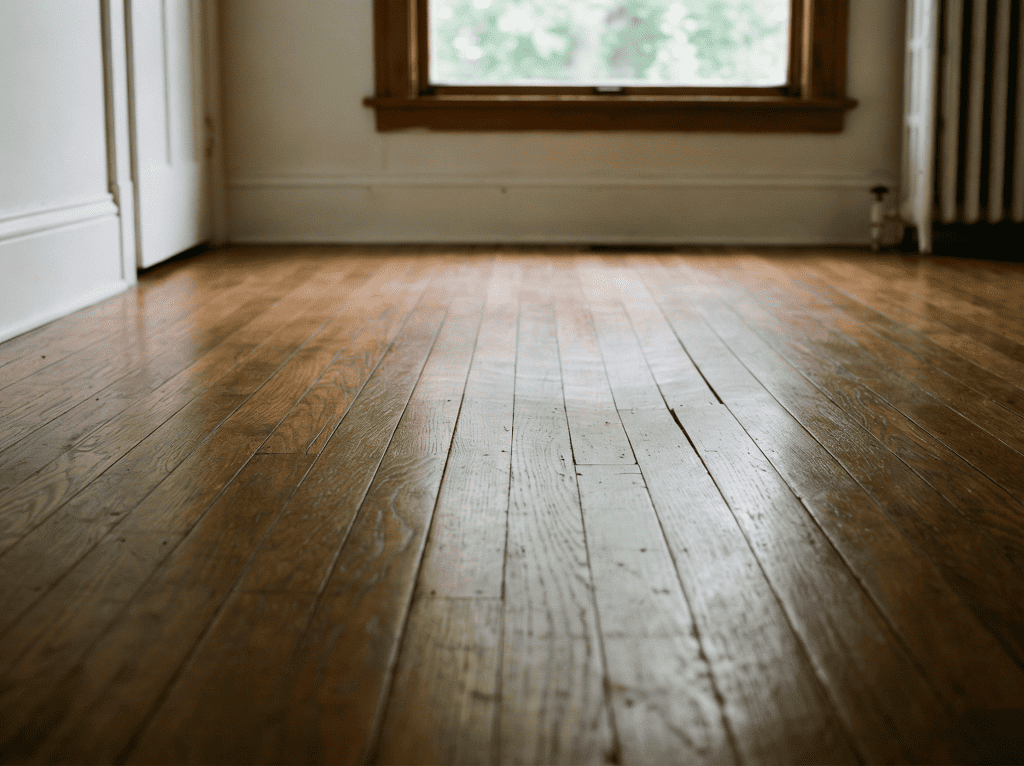
A slope you notice when you cross a room. A soft spot near the window. A second-floor bedroom that doesn’t quite feel level. Homeowners catch these things and then spend weeks second-guessing themselves.
If you’re wondering why your floors are uneven, the honest answer is: there’s more than one reason, and the urgency depends almost entirely on which one you’re dealing with. This article covers every floor level, every house age, and the specific questions that buyers and longtime owners tend to ask. For a general overview of uneven floors as a problem category, that page is a good starting point. But if you want to understand what’s going on in your specific house, keep reading.
Why Are My Floors Uneven? The Main Causes in BC Homes
Floors go uneven for four distinct reasons. Knowing which one applies determines whether you need to act now, keep an eye on things, or stop worrying about it entirely.
Foundation settlement. The foundation has moved unevenly. One corner or side has dropped relative to the others. This is the most serious cause because it tends to compound over time if nothing is done. A sinking foundation doesn’t correct itself, but it doesn’t always require major work either, especially if it’s caught and assessed before the movement accelerates. Foundation settlement almost never shows up on the floor alone. You’ll usually see it alongside other symptoms.
Crawl space deterioration. Posts, beams, or joists in the crawl space have rotted, compressed, or shifted. BC’s wet climate creates the conditions for this more than most places. A wood post sitting in a damp crawl space for 30 years can rot from the base without any visible sign from above. If your home has a crawl space, it’s often the first place worth checking. Crawl space repair addresses this directly and is one of the more common fixes for sloping floors in the Lower Mainland and Fraser Valley.
Framing damage. Floor joists have sagged, rotted, or been compromised during a renovation. Someone notched a joist to run a pipe, or a beam wasn’t properly supported after a wall came down. The foundation itself is fine, but the structure above it has weakened. This tends to appear as a localized soft spot or sag in one area of a room rather than a whole side of the house dropping.
Long-term settling. In older BC homes, slight slopes are often just the result of decades of gradual, even settling. A 100-year-old house that slopes slightly is not automatically a problem. Real concerns about house settling issues are worth knowing, but not every settling house is a broken house.
In older BC homes, anything pre-1970, a slight floor slope is often the building’s history showing, not an active problem. The question isn’t whether the floor slopes at all. It’s whether the slope is getting worse.

Second-Floor Floors and Why They’re Different
Second floors get noticed more quickly. They span longer distances with less direct support beneath them, which means a small amount of deflection in a floor joist becomes obvious in ways it wouldn’t on the main floor.
The symptom is often a useful clue about the cause. A floor that bounces underfoot when you walk across it is almost always a framing issue, not a foundation one. Joists that are undersized for the span, have deflected over time, or were cut or notched during a renovation, produce that springy feeling. A mid-room sag is different: that usually points to a mid-span support problem, often a post or beam in the crawl space beneath the main floor that has settled or rotted. And when one end of a room is noticeably lower than the other, that’s more characteristic of settlement. The main floor has dropped on one side, and the movement is showing up on the level above.
In Metro Vancouver and the Fraser Valley, moisture is a constant variable in all of this. Crawl spaces under BC homes take on water. Wood posts and beams that have been sitting in a damp crawl space for decades can deteriorate significantly before anyone notices. When those posts go, the structure above starts to follow, and second-floor unevenness is often how homeowners first catch it.
A sagging second floor in a BC home is more often a crawl space problem than a foundation problem, but both need an assessment, because you can’t know which one it is from looking at the floor.
How Uneven Are We Talking? A Practical Threshold
The commonly used rule of thumb: 1 inch of drop per 8 feet of floor length, roughly 1%. Under that, in a stable older home with no accompanying symptoms, is usually not urgent.
Over 1.5 inches per 8 feet is worth a professional look, regardless of the house’s age. Any noticeable slope in a home under 30 years old should be investigated. Newer homes shouldn’t show significant floor slopes unless something has gone wrong.
Two informal tests that are useful:
The marble test: set a marble on the floor and let it go. If it rolls steadily in one direction without any push, the slope is measurable. If it wanders and stops, the floor is close to level.
The bounce test: walk slowly across the floor. If there’s noticeable give underfoot in a specific spot, that’s a framing or joist issue, separate from the slope question, but still worth knowing about.
Here’s how to read where you are:
Relax: Slight slope in an older home that’s been stable for years. No sticking doors, no cracks, no change you’ve noticed. This is very often just the house.
Monitor: The slope is noticeable, seems relatively new, or you think it’s worsened. Take measurements, note them down, and come back to it in six months.
Call Now: Slope over 1 inch per 8 feet in a home under 30 years old. Any floor change paired with other symptoms like cracks or sticking doors. Any floor that feels soft or bouncy in a localized area.
Uneven Floors in Older BC Homes: Why Are My Floors Uneven Here?
This is the question that comes up most in heritage neighbourhoods. The short answer: many older BC homes have floors that slope, and most of them are fine.
Homes built before the 1960s used different framing standards. Lumber dimensions weren’t the same, spans were sometimes longer than current code would allow, and the houses have had 60-plus years to gradually shift and settle. In Vancouver’s heritage housing stock, Craftsman bungalows, character homes, older West Side properties, a slight slope is common and not alarming. The same goes for Vancouver heritage homes generally and older New Westminster neighbourhoods, where much of the stock is 80 to 100 years old. In older Burnaby homes you get a mix: some properties are 70-year-old concrete-foundation buildings, others are post-war with different structural norms.
For more detail on when house settling is normal, that article goes deeper into the distinction.
The thing to watch for is change. If you’ve lived in the house for 10 years and the floor has always sloped by the same amount, that’s a different situation from noticing a slope that’s appeared or worsened in the past year or two. Stability matters more than the degree of slope.
One exception: heritage homes with masonry foundations, rubble stone or brick, can develop accelerating settlement without obvious visual warning. The difference between foundation settlement and structural failure is worth understanding if you own one of these homes. A professional look every few years is a reasonable precaution, not because something is necessarily wrong, but because masonry foundations are harder to read at a glance.
A floor that’s been stable for 20 years in an older home is a very different conversation than one that started sloping two years ago. The timeline matters more than the angle.

Buying a House With Uneven Floors: What to Know Before You Offer
An uneven floor in a home you’re considering isn’t automatically a dealbreaker. The cause and the timeline are what you need to understand.
Before making an offer on a home with slopes, ask the seller three things: How long has the floor been like this? Has it changed since you moved in? Has anyone ever assessed it? You’d be surprised how often sellers genuinely don’t know the answers to the last two.
BC’s disclosure rules require sellers to report known material defects. But not every seller knows what’s causing their uneven floor, which means the disclosure form may be technically accurate and still leave you without the information you need. A standard home inspection will often note a slope but won’t tell you the cause or what it would take to address it. Most home inspectors aren’t foundation specialists.
A pre-purchase foundation assessment is different. It looks specifically at what’s below: the foundation, the crawl space, the posts and the beams. That’s what tells you whether the floor slope is cosmetic or structural, the information that matters when you’re deciding whether to make an offer and for how much. For a broader picture of buying a home with foundation repair history, that post is worth reading alongside this one.
In newer suburban communities, including Langley homes and other Fraser Valley developments, settling in a newer home can indicate soil that wasn’t properly compacted before construction. A floor that’s changed noticeably in the first 10 to 15 years of a home’s life deserves an explanation before you buy.
Before making an offer on a home with uneven floors, an Ossum assessment will tell you whether it’s a cosmetic quirk or something that needs addressing. Call 604-446-9967 or book a free assessment online.
When Uneven Floors Mean You Need to Call Someone
Most uneven floors don’t mean disaster. But some combinations change the calculation quickly.
Uneven floors plus sticking doors or windows is one of the more reliable signals of foundation movement. The frame of the house is racking, which is why the doors don’t operate the way they used to. This isn’t settling. Get it assessed.
Floors plus foundation cracks, especially diagonal cracks or cracks appearing in multiple spots, suggest a settlement pattern across the structure. Any floor change in a home under 20 years old also belongs in this category. Newer homes don’t develop significant slopes without a cause.
A visible gap at the base of a wall, where the wall meets the floor or where trim has pulled away, means the structure is moving. A wet or damp crawl space in combination with a sloping floor often means the moisture is the cause, not just a separate problem, and fixing the moisture source may address the floor issue directly.
An assessment gives you a clear answer, and often that answer is reassuring. The floor has been doing that for 40 years and will keep doing it for 40 more. But if something does need attention, you’ll know what it is instead of guessing.