

Why Foundation Problems in North Vancouver Are Different
North Vancouver’s combination of steep terrain, saturated clay soils, and persistent coastal rain creates a set of foundation stresses that most of the Lower Mainland simply doesn’t see on flat lots. If you’ve lived on the North Shore for a few winters, you already know: it rains here a lot, and the ground is rarely flat.
Homes in North Vancouver are built on hillside lots, bench terraces, and sloped residential streets that rise sharply above Burrard Inlet. That terrain shapes everything: how water drains, how soil shifts with the seasons, and how loads distribute across a foundation that may not be sitting on perfectly level ground.
There are three main factors that make foundation repair in North Vancouver more complicated than it is in, say, Langley or Surrey:
- Hillside and bench lots: Slope changes how soil presses against foundation walls and how runoff moves across a property.
- Clay-bearing glacial soils: Expand when wet, contract when dry, and create cyclical stress on concrete over decades.
- Age of housing stock: Many North Van properties were built in the 1960s through 1980s, when building methods and soil analysis were less rigorous than current standards require.
None of that means your home is in trouble. It means the context matters when you’re evaluating what you’re seeing.
Foundation Problems North Vancouver BC: Warning Signs to Watch For
The signs that foundation problems North Vancouver BC homeowners notice most often aren’t random. They follow patterns. On the North Shore, those patterns tend to track the wet season.
Here’s what to pay attention to:
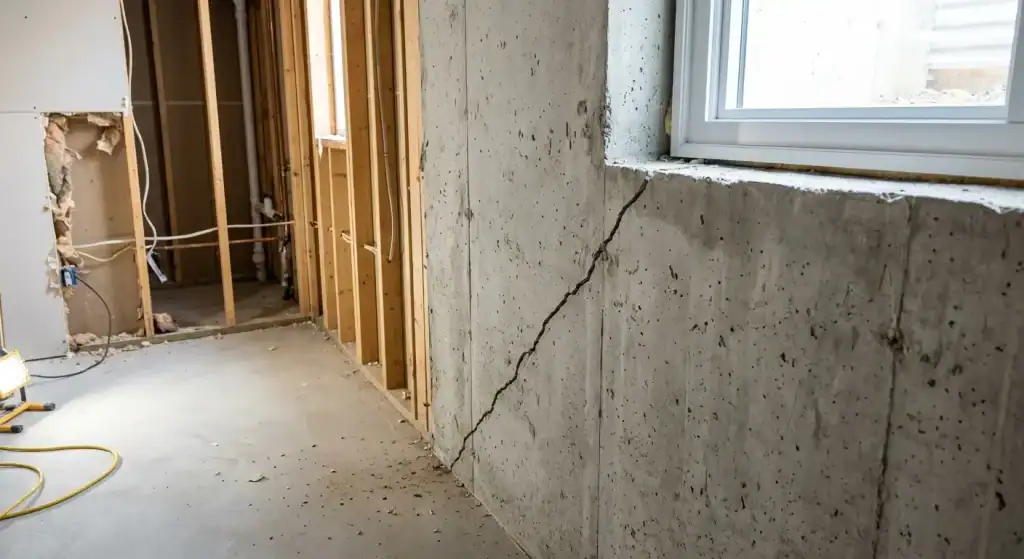
- Diagonal cracks from window or door corners. These are common on hillside lots where differential settlement is occurring, meaning one part of the home is moving more than another.
- Doors and windows sticking in fall and winter. A door that sticks every November and loosens every May isn’t just a nuisance. It’s a seasonal signal. Foundations on North Shore properties tend to move with the wet season, and that sticking is one of the earliest things homeowners notice.
- Uneven or bouncy floors. Crawl space foundations are widespread in North Van, and uneven floors are a common early indicator. Sticking doors and windows and floor issues often show up together on properties with active movement.
- Gaps between walls, trim, or ceiling. Gaps that are new or appear to be growing are worth documenting.
- Visible foundation movement on the downhill side of your property. If a foundation wall on the low side of a sloped lot shows cracking or bowing, that’s the slope’s influence showing up in the concrete.
- Water intrusion after heavy rain. On hillside lots, hydrostatic pressure from saturated uphill soil can push water through basement walls even when your drainage appears adequate.
Not all of these require immediate action. A three-tier approach helps sort them out:
- Relax: Hairline cracks under 1mm that haven’t changed in years. Normal cosmetic settling in an older home.
- Monitor: Seasonal door sticking, minor cracks near corners, small gaps that appeared recently. Document with photos and watch for changes.
- Call now: Cracks wider than 3mm, horizontal cracking in a basement wall, multiple signs appearing together, or anything that’s visibly worsened over one wet season.
If you’re seeing more than one of these signs, it’s worth getting eyes on it. Book a free assessment or call 604-446-9967.
Slopes, Soil, and Moisture: The North Shore Combination
This is where the mechanism matters. Understanding why these problems happen helps you recognize what’s serious and what isn’t.

Lateral soil pressure is the factor most homeowners haven’t heard of. On a flat lot, soil presses straight down on a foundation. On a sloped lot, saturated soil doesn’t just press down. It presses sideways. That lateral pressure is what causes basement walls to bow inward, and it compounds every wet season. Older concrete block foundations, which are common in North Van, are particularly susceptible to this kind of loading.
Foundation cracks that run horizontally are often a sign of this sideways pressure, rather than the vertical or diagonal cracks that appear in typical settling. Horizontal cracking in a basement wall deserves a professional look.
Clay soil expansion adds another layer. Parts of North Vancouver and the areas where West Vancouver homeowners face similar challenges contain glacially deposited clay that expands when wet and contracts when dry. Each wet season pushes the soil outward; each dry summer lets it pull back. Over the years, that cycling works on concrete the same way freeze-thaw works on pavement. The causes of foundation problems resource goes deeper on this if you want the full picture.
Freeze-thaw at elevation matters for upper North Vancouver properties, particularly near the base of the mountains. These areas see more freeze-thaw cycles than lower Metro Vancouver, which accelerates crack propagation in concrete. The foundation problems on sloped BC properties guide covers this dynamic for properties across the province, with North Shore terrain as one of the primary examples.
Drainage paths from uphill lots. Homes sitting below neighbouring properties may be receiving runoff from their uphill neighbours, concentrating moisture against their own foundation wall. A downspout and drainage audit is often the first thing to look at before anything structural.
Maple Ridge hillside properties face some of the same terrain-driven dynamics, though without the same coastal moisture loading the North Shore sees. The underlying principle is consistent across BC slope terrain: slope changes how every other variable behaves.
What to Do When You Spot Foundation Problems in North Vancouver
Practical steps. No panic required.
- Document what you’re seeing. Take a photo, note the date, and record which season the problem appeared or got worse. This becomes useful diagnostic information later.
- Check whether it’s changing. A crack that’s been stable for three years is different from one that grew noticeably over one winter. Change over time is the real signal.
- Don’t try to self-diagnose slope movement. Hillside properties have more variables than flat lots. What looks like cosmetic surface cracking can be part of a larger movement pattern that only becomes clear with a trained eye.
- Book a professional assessment. An assessment is the diagnostic step. A technician will look at what’s happening, identify whether it’s cosmetic settling or active structural movement, and give you a straight answer. House raising and stabilisation and other repair approaches only come into the conversation after you know what you’re actually dealing with.
One more timing note: late spring is a useful window for assessments on North Shore properties. After a wet winter, any movement that occurred between October and April will be visible. If something has gotten worse over the season, a spring visit captures that at its peak. The spring foundation inspection checklist is a good starting point for what to look at once the rain lets up.


