If you’ve bought into Port Moody or Anmore recently, or you’ve lived on a hillside lot for years and started noticing things that weren’t there before, here’s what you’re probably trying to work out: does a sloped property mean more foundation risk? And what should you actually be watching for?
The short answer is that hillside properties do behave differently, and Port Moody and Anmore have meaningfully different soil profiles that produce different concerns. Ossum serves both communities directly. You can reach us at 604-446-9967 if you’d rather just talk through what you’re seeing.
Why Foundation Problems in Port Moody and Anmore Are Different
Most articles about foundation problems on hillside properties lean on broad generalizations. “BC’s rainy climate.” “Sloped terrain.” Those statements aren’t wrong, but they’re not particularly useful if you’re trying to understand your specific lot.
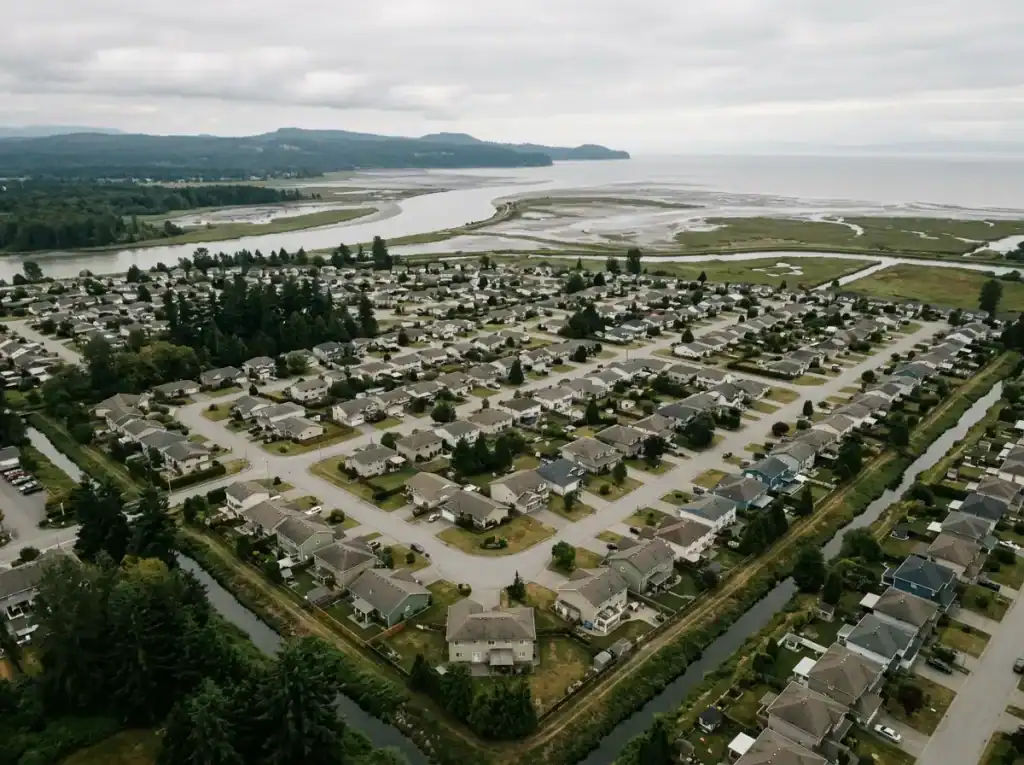
Port Moody sits at the head of Burrard Inlet, where the terrain rises sharply from the waterfront into steep, ravine-cut slopes. The residential streets on the upper plateau look stable, but sections of the slope areas, particularly around the Chines Escarpment and the Corona Crescent neighbourhood, have a documented history of slope instability. The City of Port Moody has managed landslide risk in those ravine corridors for decades. Lower-elevation properties near the inlet itself sit on a different mix of glaciofluvial deposits, silt, sand, and clay. Those soils respond to seasonal wet-dry cycles in ways that flat urban lots in Burnaby or Surrey simply don’t.
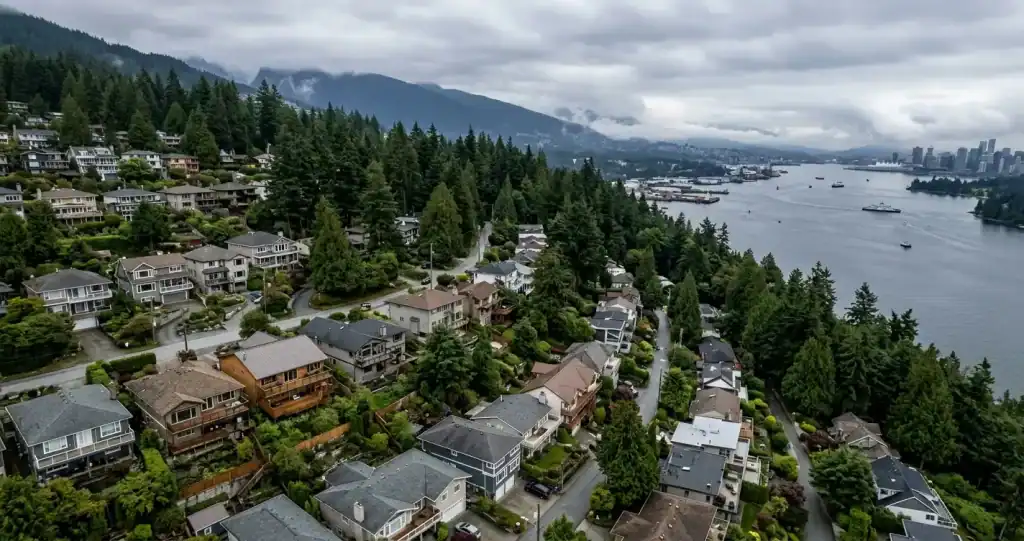
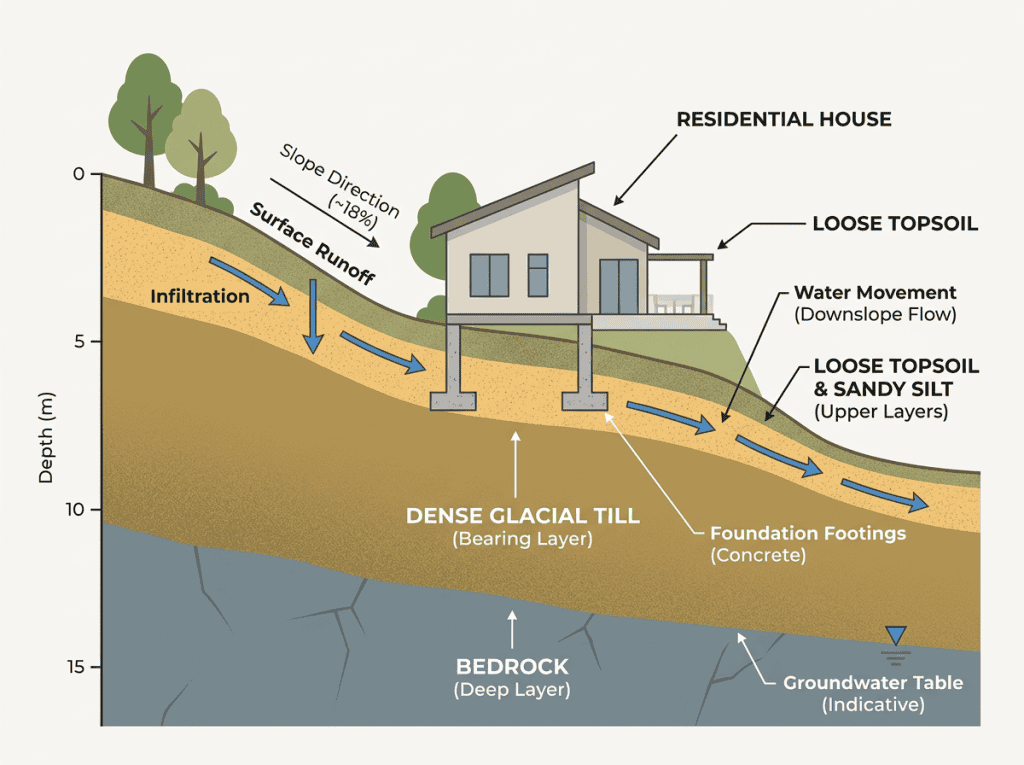
Anmore is its own thing. Foundation repair in Anmore almost always involves steep hillside lots on very dense glacial till, with granitic bedrock below that. The till itself is good bearing material at depth. But the 0.3 to 0.6 metres of post-glacial topsoil and sandy silt sitting on top of it is loose, variable, and moisture-sensitive. Add steep grades and large, partially forested lots, and you’ve got a drainage environment that standard flat-lot construction practices don’t account for.
Neither community is dramatically “high risk.” But the flat-lot assumptions about soil behaviour, drainage, and foundation loading don’t apply in either place. That’s the point, and it’s worth understanding before you decide how closely to pay attention to what your house is doing.
If you’re in the broader Tri-Cities area around Coquitlam or Port Coquitlam, the terrain transitions to lower-lying river-adjacent land, and the foundation concerns shift accordingly. Port Moody and Anmore warrant their own look.
Hillside Lots, Inlet Proximity, and Mixed Geology
This section gets into the soil science, because it’s what explains the signs you’ll see later.
Port Moody’s lower streets and inlet-adjacent areas:
The soils near Burrard Inlet tend to be softer and more sensitive to moisture. Seasonal wet-dry cycles cause modest expansion and contraction that, over time, translates to gradual and often uneven foundation settlement. Below-grade walls in these areas also face more hydrostatic pressure than they would on a drained upland site.
Port Moody’s slope and ravine areas:
Colluvial soil, deposited by gravity on slopes over time rather than settling naturally in place, is less predictable as bearing material than compacted or naturally settled soil. Add upslope development, roads, and impervious surfaces that concentrate runoff into channels the original landscape didn’t create, and groundwater can accumulate against footings in ways that weren’t happening before the surrounding area was built out. In Port Moody’s slope areas, the concern isn’t usually the soil at depth. It’s how water moves through the surface layer and concentrates against foundations over time.
Anmore:
Anmore sits on some of the densest glacial till in the Lower Mainland, but that doesn’t make every foundation problem-free. The post-glacial surface soils are loose, moisture-sensitive, and the grades are steep enough to change how water behaves across a property. The dense till and bedrock below that surface layer are good news for any foundation that reaches them. The engineering question is whether the original footings were designed to get there.
Soil types and what they mean for foundations:
- Glacial till (Anmore, at depth): Dense, compacted, good bearing material. The target layer for a well-designed footing.
- Post-glacial sandy silt (Anmore surface, 0.3–0.6 m): Loose, variable silt content, moisture-sensitive. This is the problem layer. It cannot reliably bear load on its own.
- Colluvium (Port Moody slopes): Gravity-deposited, structurally variable, prone to groundwater concentration. Less reliable than settled soil.
- Glaciofluvial mix (Port Moody lowlands): Sand, silt, and clay combination that responds to moisture changes and seasonal pressure fluctuations.
Properties on the North Shore deal with similar slope and soil dynamics. Maple Ridge hillside lots have comparable post-glacial surface soil challenges. The general principles behind foundation problems on sloped properties in BC apply here, though the soil details in Port Moody and Anmore are specific enough to warrant the community-level breakdown above. For the broader picture, understanding what causes foundation problems in the first place provides useful context.
Foundation Problems Port Moody: The Warning Signs
The foundation problems Port Moody BC homeowners most commonly notice on hillside and inlet-adjacent properties develop gradually, and often unevenly. On a slope property, one side of the house can be sitting on materially different soil than the other side. The upslope portion is on different material than the downslope portion, and that differential is what produces asymmetric settlement. In ravine-adjacent areas, concentrated drainage and groundwater can erode soil from beneath footings quietly, and for years, before any surface cracking appears.
Here’s what to watch for:
- Diagonal cracks from door and window corners: Classic indicator of differential settlement. One corner of the opening is moving; the other isn’t.
- Doors or windows that stick on one side of the house only: If problems are concentrated on one wall or corner, it often means that part of the foundation is moving while the rest stays put.
- Floors that slope noticeably toward the downhill side: Worth measuring if you’re uncertain. A level placed across several points will give you a clear answer.
- Gaps at exterior corners, rooflines, or where an addition meets the original structure: These often show up before obvious wall cracking becomes visible.
- Retaining walls tilting or cracking: On a hillside lot, the first sign of trouble is often a retaining wall, not the house, because the soil is moving before the foundation starts to show it.
- Soil pulling away from the foundation on the uphill side: A gap between the ground and the wall suggests the soil is settling or shifting downslope.
- Damp or wet basement on the uphill-facing wall: Hydrostatic pressure or a drainage failure is pushing moisture in from the upslope side.
- Drainage features (swales, ditches) that have shifted or stopped draining properly: Ground-level movement shows up in drainage behaviour before it shows up in the house.
Most of these sit in the “monitor” category unless they’re progressing quickly or appearing in multiples. A sinking or settling foundation often shows up first as uneven or sloping floors, doors or windows that stick or jam, or a cluster of smaller signals that seem unrelated until you see them together.
Not sure whether what you’re seeing is worth a call? That’s exactly what the free assessment is for. 604-446-9967.
Anmore Homeowners Should Know About Slope and Soil Movement
Anmore lots are often large, forested, and steep. Grades of 20 to 37% are common in the residential areas, and some sections are steeper. That context matters for understanding what your foundation is working against.
The main concern is the post-glacial surface soil. It isn’t dramatically unstable on its own, but it is loose, variable in its silt content, and sensitive to moisture. On a steep grade, that surface layer is under constant gravitational pressure. When it gets saturated, it can compact and shift enough to affect footings that aren’t properly seated into the dense till below.
New development upslope changes things, too. Roads, cleared lots, and new drainage infrastructure alter the runoff patterns your house was originally built around. Even landscape changes on your own property, including removing trees, regrading a section of yard, or redirecting a natural drainage channel, can introduce new moisture pressures the original foundation design didn’t account for.
A few things Anmore homeowners specifically should keep in mind:
- Steep grades mean longer drainage paths. Water has more surface area to collect and more distance to travel. Concentration against a downslope structure or footing is a natural result.
- Original foundation design matters. Well-built homes in Anmore are typically designed with footings that reach the dense till layer below the loose surface soil. If you’re buying an older property and don’t know the original foundation design, it’s worth finding out.
- Upslope changes affect your lot. If a neighbour regraded, a road was modified, or trees were cleared near your property line, watch for new moisture patterns in the following wet season.
- Retaining wall repair is often the first practical intervention on Anmore lots. Retaining walls are doing real structural work on steep grades, and they tend to show movement before the house does.
Foundation repair in Port Moody often involves different soil conditions and drainage scenarios than Anmore lots face, even though the communities sit close to each other. The distinction matters when assessing what you’re actually dealing with.
Getting a Foundation Assessment in Port Moody or Anmore
If you’ve been reading this article and recognizing things you’ve noticed at home, the next step is straightforward. A technician comes to the property, walks the site, and looks at the foundation in context. On a hillside lot, that walkthrough includes the slope, drainage, any retaining walls, and signs of soil movement, not just the foundation itself.
You don’t need to wait for something dramatic. Gradual, slow-moving signs are easier and less costly to address while they’re still at an early stage. A free assessment gives you a clear read on what’s happening, without any obligation.
When the scope of work requires engineering input, an engineer is brought in at that stage. The initial site assessment is done by a qualified technician.